
As consumer interest in electric vehicles continues to climb, so too does the need for trained technicians to service those vehicles. A new electric vehicle training station, donated by the Mercedes Benz Educational Foundation, will help Northwest Technical College automotive students learn to service electric vehicles in a safe, controlled environment.
Mark Johnson, NTC automotive services technology faculty, says the donation will help Bemidji’s technical college adapt to an evolving automobile market in a state that saw electric vehicle registrations increase nearly tenfold between 2016–2024.
“If you think of any standard cars out there, high-voltage electrical systems are mainly in the ignition,” Johnson said. “As we’re moving into more and more hybrid and electric vehicles, we’re dealing with systems that weren’t in automobiles in the past.”
NTC will receive an EV-400 electric vehicle safety trainer, manufactured by Canadian-based Consulab. With the trainer, students in NTC’s hybrid and electric vehicles course will be able to experience the full power of an electric vehicle system without risk of serious injuries.
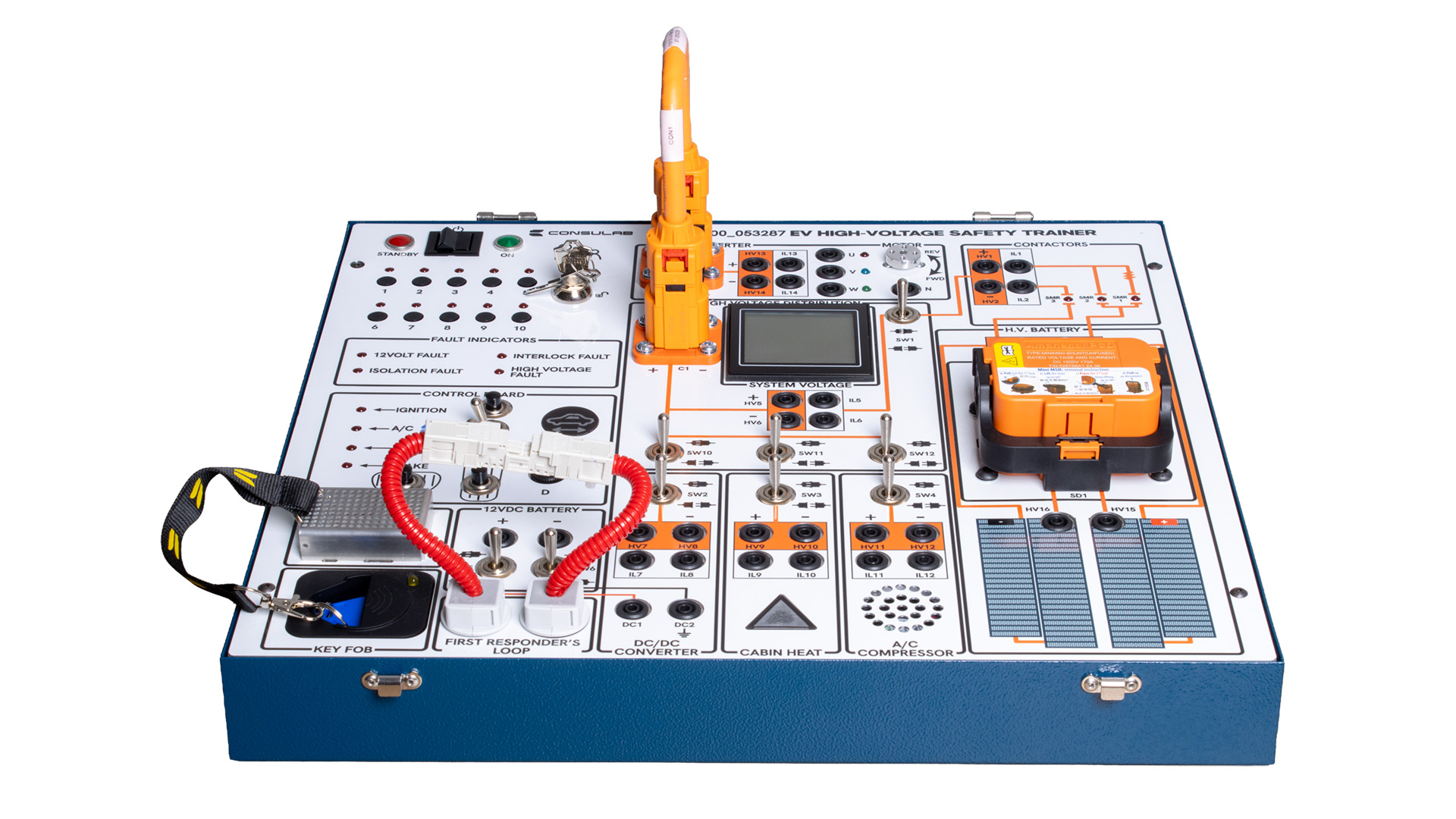
Above: Consulab EV-400. Image courtesy of Consulab.
“If you’ve ever been zapped by a spark plug wire, it’s high voltage and it hurts. But when you move into hybrid and electric vehicles you have high current or amperage, which is where you can get hurt when it comes to electricity,” Johnson said. “With the EV-400 if a student makes a mistake it will still shock them, but they’ll walk away. It gives students a chance to work on those systems in a safe environment.”
Johnson said that in addition to providing a simulation for an EV’s electrical systems, the trainer will also include an instructional curriculum and guides for safely maintaining a battery-powered electric or hybrid vehicle.
He said the trainer is particularly helpful as NTC continues to explore creative ways to provide opportunities for its automotive students to work on electric vehicles. The program has been able to borrow Toyota Priuses from its sister school Bemidji State University, and Bemidji-based Knife River Materials has loaned vehicles to NTC as well.
“This trainer will bridge the gap there,” Johnson said. “Our students will be able to do more in that course than they would have been able to do in the past.”
The EV-400 donation continues NTC’s relationship with the Mercedes Benz Educational Foundation. Last year, the foundation also provided NTC’s automotive program with a dial bore gauge, a crucial tool in rebuilding and overhauling engines.
“We’re grateful for the Mercedes Benz Foundation’s interest in supporting our program,” Johnson said. “These donations are improving the quality of education that we’re able to provide our students, and that will lead to better mechanics providing better service after they graduate.”
Support from Jim Walrath, a Mercedes-Benz Club of America board member and Bemidji State University alumnus, has been a driving influence behind both equipment donations. Walrath graduated cum laude from BSU in 1971 with a bachelor’s degree in physical education and health. A four-year track and field and cross-country athlete, he was inducted into BSU’s Athletic Hall of Fame in 1998.
Walrath is part of the Mercedes-Benz Club of America’s Twin Cities Section, based in Minneapolis-St. Paul, dedicated to fostering appreciation for Mercedes-Benz automobiles. The club organizes driving and social events, provides technical support and promotes education through newsletters and outreach programs.
About NTC’s Automotive Service program
The Automotive Service and Performance program at NTC earned Master Automotive Service Technology accreditation from the National Institute for Automotive Service Excellence, the highest level of recognition by the institute, in 2024. ASE Education Foundation evaluates programs using national standards measuring instruction, facilities and equipment.