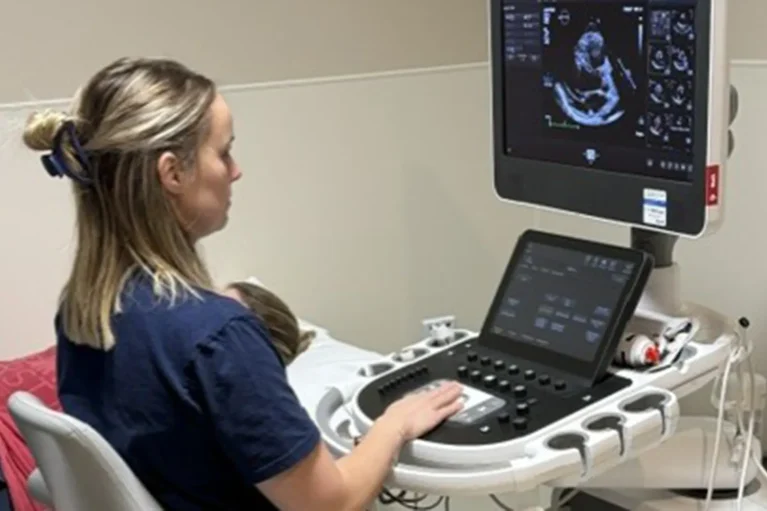
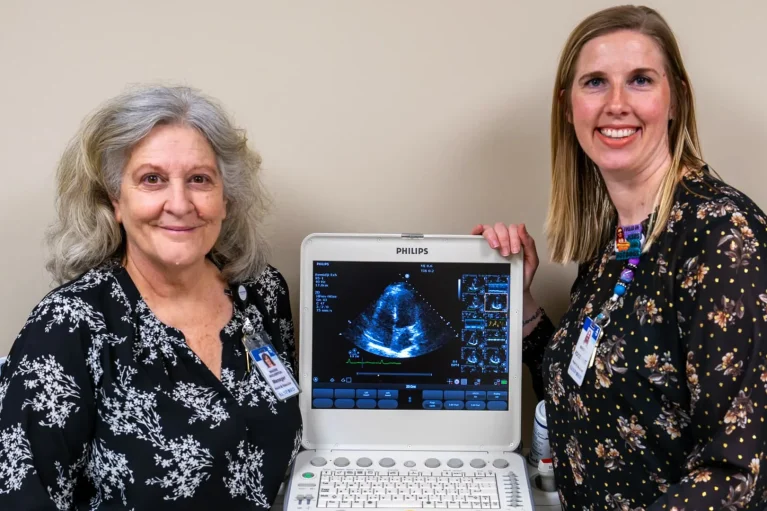
The Cardiac Sonography program at Northwest Technical College prepares students to become skilled healthcare professionals who use ultrasound technology to capture detailed images of the heart. These images play a vital role in helping physicians diagnose and treat cardiovascular disease.
Throughout the program, you’ll learn to operate ultrasound equipment, interact with patients, and understand essential concepts of cardiac anatomy, physiology, and function—all within a supportive, hands-on learning environment.
What sets this program apart is its strong emphasis on real-world, practical experience. You’ll spend extensive time developing your scanning abilities in on-campus labs and during clinical settings, not just in lecture-based coursework. Classes are taught by experienced sonographers and professionals who bring real field expertise to the classroom, ensuring you’ll gain the knowledge and skills that employers actively seek.
Lecture courses provide a solid foundation in cardiac anatomy, physiology, pathology, ultrasound physics, and patient care. These concepts are reinforced through scanning labs, where students practice image acquisition using echocardiography equipment in a controlled, supportive setting.
As you advance in the program, you’ll participate in clinical education at approved clinical sites. During these rotations, you’ll apply your learned skills in real healthcare environments under the supervision of registered cardiac sonographers and physicians, gaining meaningful patient-care experience and exposure to daily clinical workflow.
Program Snapshot
| Program | Degree | Length of Program | Delivery Method |
|---|---|---|---|
| Cardiac Sonography | Associate of Applied Science (AAS) | Five semesters | On-Campus |
Why Attend NTC’s Cardiac Sonography Program?
- High-demand career field | Cardiac sonography is a growing specialty with strong job placement opportunities in hospitals and cardiology clinics.
- Small class sizes | You’ll benefit from individualized instruction, hands-on coaching, and direct access to faculty.
- Strong clinical partnerships | Established relationships with regional healthcare facilities provide meaningful clinical experiences and professional networking.
- Workforce-ready focus | Curriculum is designed around real clinical workflows, preparing graduates to step confidently into entry-level positions.
- Certification preparation | Coursework and clinical training align with national registry expectations, supporting graduate success on certification exams.
Admission to the Program
The following steps will guide you through the admission process for the Cardiac Sonography program.
Step 1: Admission into Northwest Technical College
Step 1: Complete Northwest Technical College’s free application.
Step 2: Submit High School or GED Transcript – Skip this step if you’ve already completed 24 or more college credits.
- How to send an official transcript:
- Digital: Sent by your school through the Parchment transcript service, the National Student Clearinghouse transcript service, or emailed directly from the issuing institution to admissions@ntcmn.edu.
- Mail: Sealed paper copy to Northwest Technical College, Office of Admissions, 905 Grant Ave SE, Bemidji, MN 56601.
- GED: Request through your state’s Department of Education and have it sent to admissions@ntcmn.edu or by mail.
Step 3: Submit College/University Transcripts
- MinnState Schools:
- If you’ve attended a Minnesota State college or university since the early 1990s, NTC can usually retrieve your official transcript automatically when your NTC application is processed.
- If your record was created before electronic systems or if you have an unpaid balance at a previous MinnState school, that transcript cannot be released, you’ll need to contact that school directly to request a paper copy.
- Note: The University of Minnesota is not part of the MinnState system and must be requested separately.
- Military Transcripts
- Active-duty and veteran service members with creditable military experience or coursework may request a Joint Services Transcript.
- Use the American Council on Education’s resource to get started.
- Once your JST has been released to Northwest Technical College, our office will be able to download it electronically on your behalf.
- Non-MinnState (U.S.):
- Request through your school and have transcripts sent to admissions@ntcmn.edu, via the Parchment transcript service, the National Student Clearinghouse transcript service, or by mail to the address listed above.
- International Transcripts: Must be evaluated by a recognized evaluation service. You can choose either
Transfer Students: After you’re admitted to NTC, your official college transcripts are evaluated to determine how previously completed coursework transfers toward your program. Your transfer credit results will appear in eServices under your Degree Audit Report (DARS) once processing is complete.
Step 2: Math Readiness
Students must demonstrate college readiness in Math through one of the following options:
- Completion of approved college-level coursework (Math: MATH 0081/0092+) within 5 years
- Qualifying Accuplacer score (Math: 240+)
- High School GPA of 2.6+ (if graduated within the past 10 years)
- ACT score of 22+ (within 5 years)
- Completion of NTC’s Guided Self-Placement Form for Math
Step 3: Prerequisite Requirements for the Cardiac Sonography Program
Prerequisite Courses, earn a grade of a C or Higher – Must be completed or enrolled to apply
- BIOL 2260 Anatomy & Physiology I — 4 credit
- HLTH 1106 Medical Terminology — 2 Credit
- Prerequisite GPA must be 2.76 or Higher
Additional Requirements
- Nursing Assistant (CNA) Requirement
- Certified Nursing Assistant active within last 5 years
- HLTH 1110: Nursing Assistant Course (or equivalent) completed within last 5 years
- CNA Waiver Approved by the Nursing Department – To request a waiver, please email nursingapp@ntcmn.edu
- HSRT-AD ExamRequirement
- HSRT-AD Exam score must be ≥ 70
- Exam must be taken be taken on campus at Northwest Technical College (Bemidji, MN)
- Exam must be completed within two years of Cardiac Sonography application the student is applying for
Transcript and Coursework Verification
Applicants are responsible for ensuring that all completed and in-progress prerequisite coursework is accurately reflected on their Northwest Technical College academic record or degree audit.
Coursework completed through another Minnesota State institution may be available electronically; however, applicants must still verify that the coursework has been received, evaluated, and applied correctly to their NTC record. Coursework completed outside the Minnesota State system requires an official transcript sent directly to Northwest Technical College.
Submitting an application does not replace the transcript submission or transfer-evaluation process. Applicants should allow sufficient time for transcripts to be received and coursework to be evaluated before the application deadline.
Transcripts, proof of enrollment, course substitutions, or other application materials submitted after the application deadline may delay or prevent application review and may affect an applicant’s eligibility for ranking, waitlist consideration, or seating. Applicants assume the risk that materials submitted after the deadline may not be reviewed for the current application cycle.
Step 4: Complete the online Cardiac Sonography Application
During an active application window:
- Complete the Online Cardiac Sonography Application, which is separate from the institutional (college) application.
- Admission is competitive based on selection criteria and rankings from candidate GPA and exam scores. Meeting all requirements does not guarantee acceptance.
Application Timeline:
- Fall 2027 application opens: November 1, 2026
- Fall 2027 application closes: February 1, 2027
- Fall 2026 Application Window is CLOSED
Step 5: Next Steps for Accepted Cardiac Sonography Students
Once you have been formally accepted into the Cardiac Sonography program, you will be required to perform several tasks.
- Submission of your immunization record with documentation of all required immunizations (at student expense)
- Complete a criminal background check (at student expense)
- Undergo a student physical (at student expense)
- Present proof that you carry health insurance (at student expense)
- Complete required documents provided to you by program administrator
NTC and Sanford Health